““Animals mask pain; it is our duty to read their silent whispers before they become screams.””
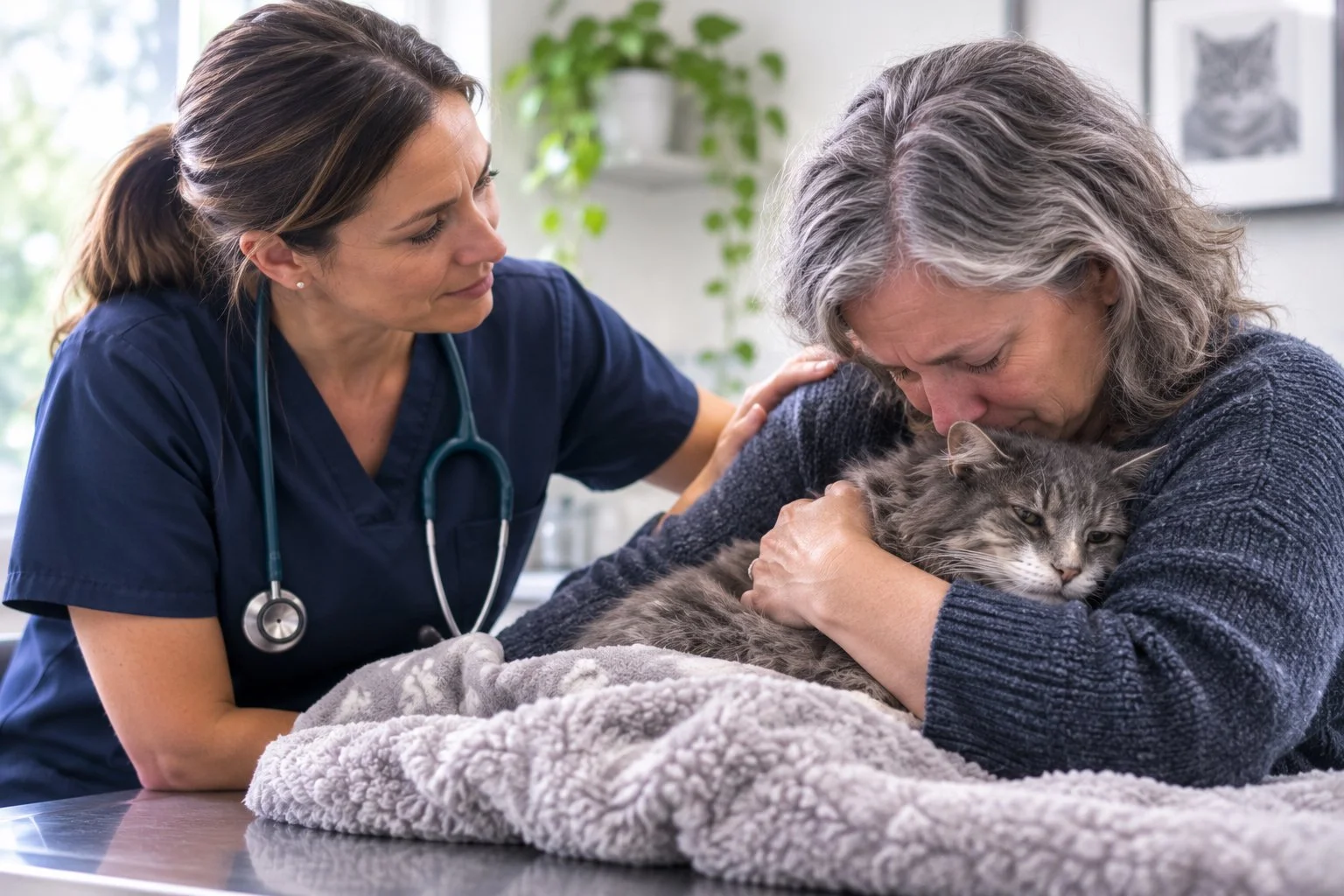
Supporting Veterinary Teams Through End-of-Life Care
At Paws Forever, we believe the best end-of-life care happens when veterinary teams, families and dedicated in-home euthanasia services work together.
Our role is not to take patients or replace the relationship between a family and their regular veterinarian. It is to provide an additional layer of support when a pet is approaching the end of their life—helping families understand pain and declining quality of life, prepare for what lies ahead, and have difficult conversations before they become a crisis.
We encourage veterinary teams to start these conversations early. When a pet receives a poor prognosis, a terminal diagnosis, or begins to show a meaningful decline in quality of life, families should be given the opportunity to start thinking about end-of-life care while their pet is still comfortable. Quality-of-life scales, good-day/bad-day tracking and palliative-care planning can help families recognise changes and make informed decisions over time.
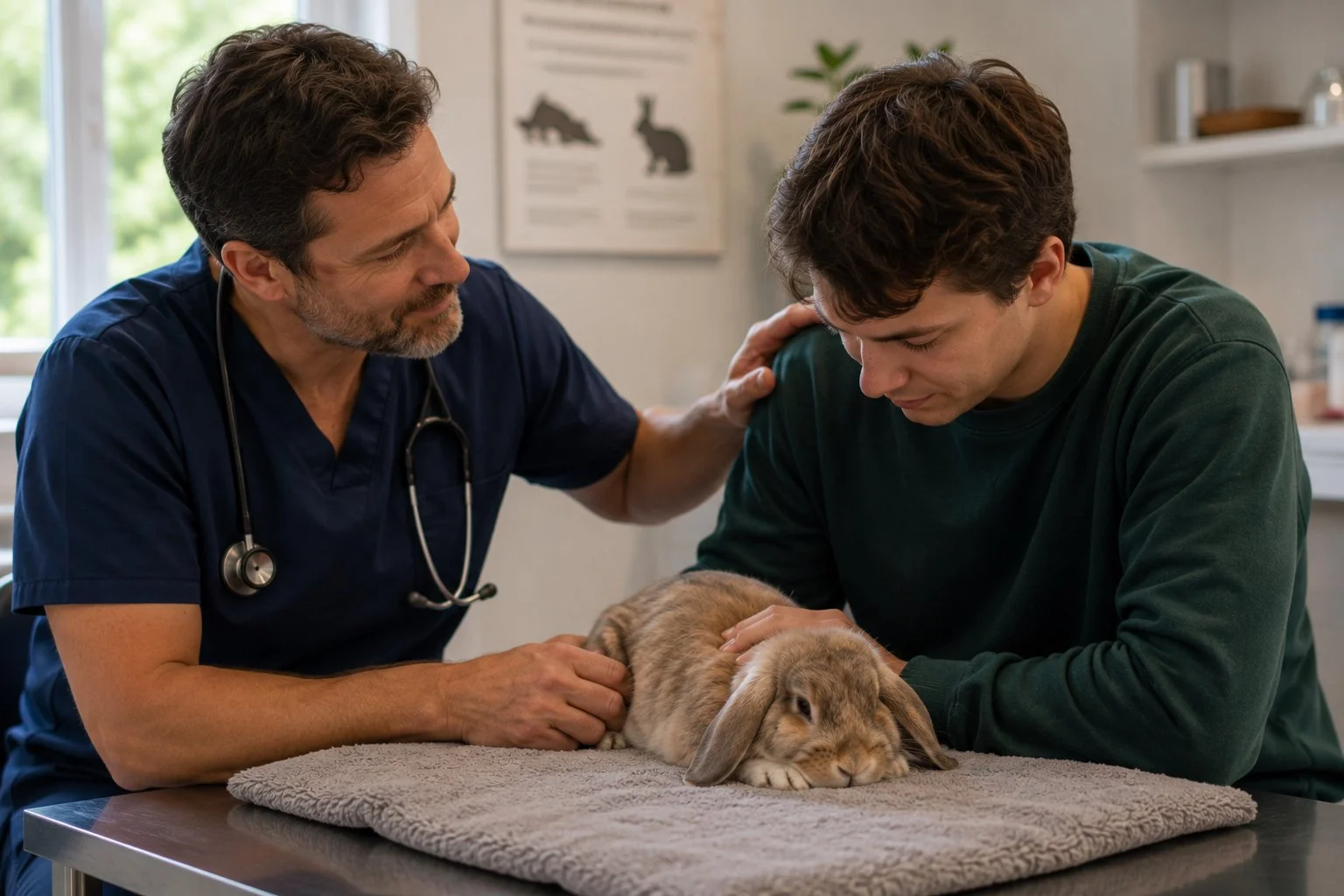
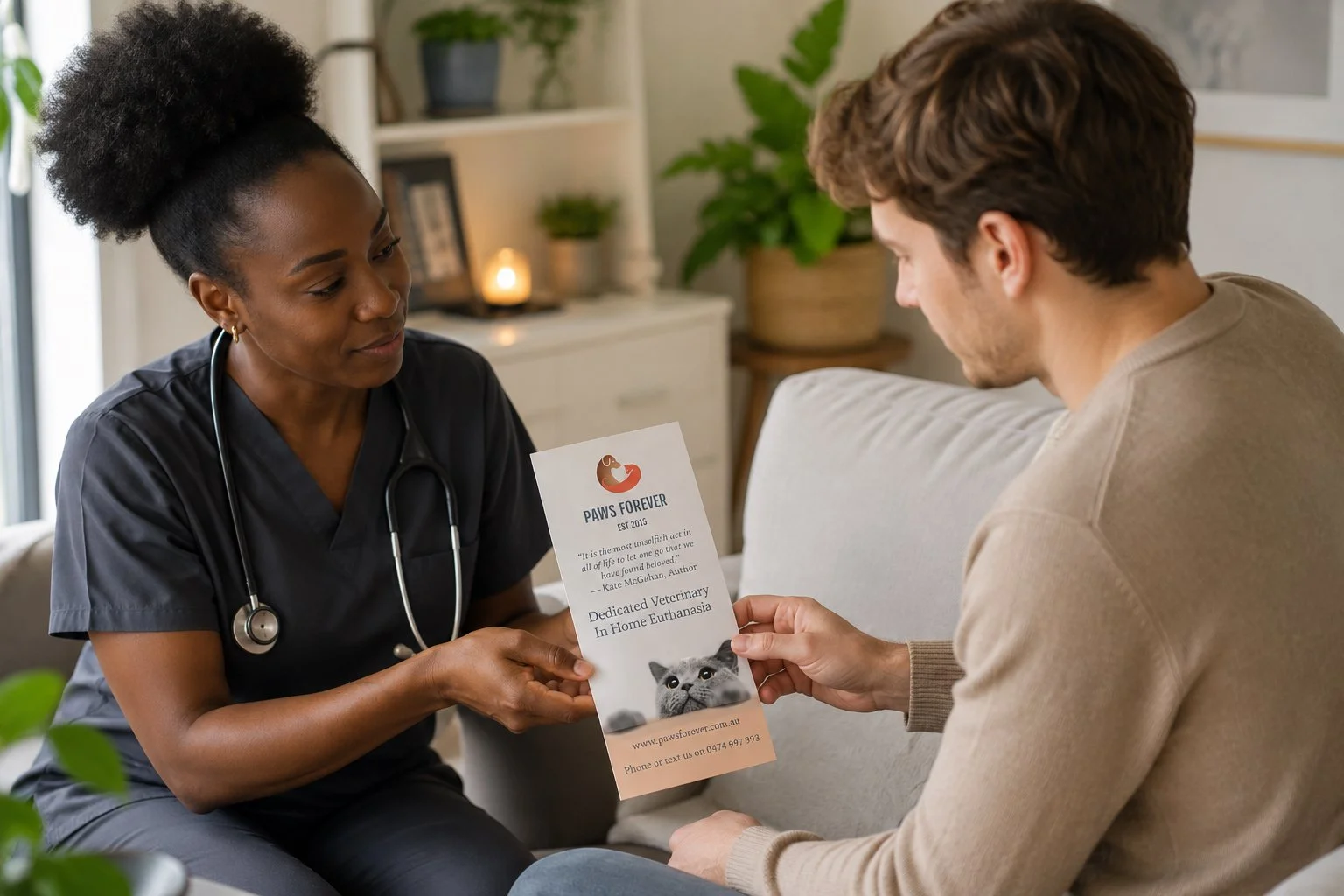
A simple brochure and an early recommendation to contact us can make an enormous difference. Families do not need to be ready for euthanasia. They simply need to know what their options are, who they can contact and what to expect when the time eventually comes.
We provide pre-, intra- and post-euthanasia support, helping families understand the process, prepare for the appointment, navigate grief and access additional pet-loss and counselling resources when needed. We follow up with every family after their appointment and remain available if they need support hours, days, weeks or even months later.
We are also here to support you and your veterinary team. If you find end-of-life conversations difficult, don’t have enough time during a consultation, or simply want advice about how to approach a particular family, we are happy to help. We can speak directly with owners when appropriate, provide resources and brochures for your clinic, and offer further information or training for veterinary teams.
We aren’t here to take your patients. We’re here to help you care for them all the way to the end.
Because preparing early isn’t giving up.
Preparing is caring.
-
When pain doesn’t look like pain
One of the most important responsibilities we have as veterinary professionals is recognising pain.
Yet pain in animals can be remarkably difficult to identify.
We often look for the obvious signs:
Whining.
Crying.
Limping.
Panting.
Trembling.
Reacting when a painful area is touched.
But many animals don’t show pain in these obvious ways.
They don’t necessarily cry when they hurt.
They may still eat.
They may still wag their tail.
They may still seek affection.
They may even appear completely normal for periods of time.
The absence of vocalisation is not the absence of pain.
Animals have evolved to hide vulnerability, and chronic pain can be particularly subtle. Instead of dramatic signs, we may see gradual changes in behaviour, activity, appetite and interaction.
Sometimes the most important clinical sign isn’t something the animal has started doing.
It’s something they have stopped doing.
Look for change, not just obvious pain
One of the most useful questions we can encourage veterinary teams and owners to ask is:
“What has changed from this pet’s normal?”
Owners often notice these changes long before they describe their pet as being “in pain.”
Perhaps their dog used to race to the front door when they came home.
Now they lift their head from their bed but don’t get up.
Perhaps they used to enthusiastically bring the lead when it was time for a walk.
Now they hesitate at the door.
Perhaps they used to finish every meal.
Now they turn their nose up at their normal food but eagerly accept treats.
Perhaps they used to bark when someone approached the house.
Now they barely acknowledge the doorbell.
Perhaps they used to follow their owner from room to room.
Now they spend most of the day sleeping.
None of these changes, individually, proves that an animal is experiencing pain.
But collectively, they tell us that something has changed.
And that change deserves investigation.
The subtle signs of pain we can miss
Pain can manifest through a surprisingly broad range of behavioural changes.
Look for:
Reduced appetite
Becoming selective about food
Only accepting treats or particularly tasty foods
Eating more slowly
Reluctance to get up
Difficulty lying down or getting comfortable
Sleeping considerably more
Reduced interest in walks
Shorter walks
Stopping frequently during walks
Reluctance to climb stairs
Difficulty jumping onto furniture
Changes in posture
Reduced grooming
Spending more time alone
Reduced interaction with family
No longer greeting people at the door
Reduced interest in play
Changes in toileting
Difficulty getting up to toilet
Increased irritability
Avoiding handling
Changes in facial expression or body language
Many of these signs can also occur with other medical conditions.
That is precisely why they should prompt investigation rather than assumption.
An elderly dog sleeping more may be ageing.
Or they may be painful.
A cat hiding more may simply prefer solitude.
Or they may be unwell.
A rabbit eating only treats may be fussy.
Or they may have significant oral pain.
The job is not to assume.
The job is to ask why.
“But they’re still eating.”
This is one of the most common reassurances owners give themselves.
“He’s still eating.”
But eating isn’t necessarily an all-or-nothing measure.
A pet may stop eating their normal food but eagerly accept treats.
They may refuse dry food but eat soft food.
They may approach the bowl but eat only a small amount.
They may need to be hand-fed.
They may only eat particularly palatable foods.
The question isn’t simply:
“Are they eating?”
It is:
“Are they eating normally for them?”
A significant change in appetite or food preference deserves attention, particularly when it occurs alongside other behavioural changes.
“They’re just getting old.”
Ageing is often used to explain away changes that should prompt further investigation.
“She’s just slowing down.”
“He’s old now.”
“She sleeps all day because she’s elderly.”
“He doesn’t like walks anymore because he’s getting older.”
But ageing itself isn’t a diagnosis.
An older animal may naturally change their behaviour and activity level.
However, pain, arthritis, dental disease, neurological disease, organ dysfunction, cancer and many other conditions can also produce changes that appear to be “just ageing.”
When a pet changes, we should ask:
Is this normal ageing—or is something making them feel unwell?
The importance of the owner’s observations
The veterinary consultation gives us a snapshot.
The owner sees the pet every day.
They see how they get out of bed.
They see whether they want to go for a walk.
They see what happens when the front door opens.
They see whether dinner is exciting or simply something the pet tolerates.
They see whether their cat still jumps onto the windowsill.
They see whether their rabbit still races towards food.
They see whether their pet chooses to interact with the family or retreats to bed.
These observations are incredibly valuable.
Rather than simply asking:
“How is he doing?”
we can ask much more specific questions:
“What happens when you come home?”
“Does he still get up to greet you?”
“Does he still want to go for his usual walk?”
“How far does he walk compared with six months ago?”
“Does she still jump onto the couch?”
“Does he still play?”
“Is she eating her normal food?”
“Does she still interact with the family?”
“What are the things your pet used to love doing that they no longer do?”
Sometimes these questions uncover an entirely different picture from the one initially presented in the consultation room.
Good days and bad days
Quality of life is rarely completely black and white.
Many animals have good days and bad days.
This can make end-of-life decisions incredibly difficult for families.
A pet may have a wonderful morning and then spend the afternoon uncomfortable.
They may still enjoy their favourite treat.
They may still wag their tail.
They may still have moments where they seem completely like themselves.
And the family quite reasonably thinks:
“But look at them today. They’re happy.”
That moment matters.
But it is only one moment.
The more useful question is:
What does the overall pattern look like?
One good day doesn’t necessarily mean good quality of life
This is perhaps one of the hardest concepts for families to understand.
A seriously ill pet can still experience moments of happiness.
They can enjoy food.
They can enjoy cuddles.
They can enjoy sitting in the sun.
They can become excited to see their owner.
They can have a genuinely lovely day.
And still have a quality of life that is declining.
We shouldn’t take those good moments away from families.
They are precious.
Instead, we can help families place them within the bigger picture.
Ask:
How often are the good days happening?
How often are the difficult days happening?
Are the good days becoming shorter?
Are the bad days becoming more frequent?
Is recovery from a bad day taking longer?
Are the things that make a good day possible becoming harder to achieve?
This is where looking at trends becomes so important.
The trend matters more than the individual day
Imagine two pets.
Pet A
Monday — good
Tuesday — good
Wednesday — good
Thursday — difficult
Friday — good
Saturday — good
Sunday — good
There is a difficult day, but the overall pattern remains positive.
Pet B
Monday — good
Tuesday — difficult
Wednesday — good
Thursday — difficult
Friday — very difficult
Saturday — good
Sunday — very difficult
This pet may still have good days.
But the pattern is changing.
The good days are becoming less reliable.
The difficult days are increasing.
That is clinically meaningful.
What does a “good day” actually mean?
This is different for every animal.
A good day isn’t necessarily a day when the pet looks perfect.
It is a day when they are able to experience the things that matter to them.
For one dog, that might mean going for a walk.
For another, it might mean lying in the garden with their family.
For a cat, it might mean grooming, eating comfortably and sleeping in their favourite spot.
For a rabbit, it might mean enthusiastically eating, exploring their environment and interacting normally.
A useful question is:
“What does your pet love doing?”
Then:
“Can they still do it comfortably?”
And perhaps most importantly:
“Do they still want to?”
What does a bad day look like?
A bad day might include:
Significant pain or discomfort
Poor appetite
Difficulty eating
Difficulty breathing
Repeated vomiting or diarrhoea
Inability to move comfortably
Inability to toilet normally
Significant anxiety or restlessness
Withdrawal from family
Inability to settle
Spending almost the entire day asleep
No interest in previously enjoyable activities
Requiring considerable assistance with basic needs
Again, one bad day doesn’t necessarily mean that euthanasia is immediately appropriate.
But repeated or increasingly severe bad days deserve attention.
Sometimes the biggest change is the loss of joy
Quality of life isn’t simply about the absence of disease.
It is also about the presence of things that make life meaningful for that individual animal.
A pet may technically be eating, drinking and toileting.
But are they enjoying their life?
Are they interacting?
Are they curious?
Are they comfortable?
Are they seeking affection?
Are they interested in their surroundings?
Are they still experiencing moments of genuine pleasure?
A pet doesn’t need to be doing everything they did when they were young.
But there should ideally still be something they look forward to.
Help owners measure rather than remember
One of the most useful things we can do is encourage owners to record what they are seeing.
Memory is surprisingly unreliable, particularly during emotionally difficult periods.
A family may remember the wonderful afternoon they had with their pet on Sunday and forget the three mornings beforehand when their pet couldn’t comfortably get out of bed.
This is where a quality-of-life scale can be extremely helpful.
Rather than relying on memory, owners can record their pet’s quality of life over several consecutive days.
We recommend considering a 3–5 day period where appropriate, particularly when the pet’s condition fluctuates.
This allows the family and veterinary team to look at a pattern rather than a single snapshot.
Our Quality of Life Resources
We have developed resources to help owners assess their pet’s quality of life at home.
[Quality of Life Scales — INSERT LINK]
We also provide species-specific HHHHHMM quality-of-life scales:
[HHHHHMM Quality of Life Scale for Dogs — INSERT LINK]
[HHHHHMM Quality of Life Scale for Cats — INSERT LINK]
These tools are not intended to make the euthanasia decision for a family.
They are designed to support observation, communication and discussion with the veterinary team.
Take videos
Another remarkably useful tool is video.
Encourage owners to record their pet doing ordinary things at home.
Walking across the house.
Getting up from bed.
Going up stairs.
Getting into the car.
Eating.
Drinking.
Playing.
Interacting with the family.
Using the litter tray.
Going into the garden.
These videos can be incredibly informative.
Some behaviours simply don’t appear during a veterinary consultation.
And sometimes a 20-second video tells us more about a pet’s mobility than an owner trying to describe it from memory.
Look at the whole animal
Pain assessment and quality-of-life assessment should never be reduced to one symptom.
A pet may have a good appetite but terrible mobility.
They may walk reasonably well but be profoundly nauseous.
They may still greet their owner but spend the remainder of the day withdrawn.
They may have very little pain but significant respiratory distress.
They may be comfortable physically but no longer interested in interacting with the world around them.
Quality of life is multidimensional.
This is why the conversation needs to include physical comfort, function, appetite, hydration, hygiene, mobility, interaction, happiness and the ability to engage in meaningful activities.
We shouldn’t wait for the crisis
One of the most important opportunities we have as veterinary professionals is to start these conversations before the family reaches a crisis point.
If a pet has a progressive or terminal illness, don’t wait until the owner says:
“I think it’s time.”
Start talking earlier.
Give them a quality-of-life scale.
Ask them to observe their pet.
Encourage them to record good and bad days.
Ask what matters most to their pet.
Discuss what deterioration might look like.
Talk about pain.
Talk about palliative care.
Talk about what options will be available when quality of life declines.
This doesn’t mean we are telling them to euthanise.
It means we are giving them the information they need to recognise when their pet’s needs are changing.
Our responsibility is to listen to what the patient cannot say
Our patients cannot tell us:
“My hips hurt when I get up.”
“Eating has become uncomfortable.”
“I don’t want to go for a walk because it hurts.”
“I’m tired because I don’t feel well.”
“I don’t enjoy things the way I used to.”
They communicate those things through behaviour.
Through movement.
Through appetite.
Through interaction.
Through withdrawal.
Through the things they stop doing.
As veterinary professionals, one of our greatest responsibilities is to recognise those changes and help owners understand what they may mean.
We should never wait for an animal to cry before we consider pain.
And we should never dismiss a declining quality of life simply because a pet still has occasional moments of happiness.
Look at the whole picture.
Look for change.
Look at the trend.
Look at the good days and the bad days.
And most importantly:
Listen to the people who know the patient best.
Because sometimes the clearest sign that an animal is struggling isn’t found during the examination.
It’s found in the sentence an owner says quietly:
“She’s just not herself anymore.”
That sentence deserves our attention.
-
When pain doesn’t look like pain
One of the most important responsibilities we have as veterinary professionals is recognising pain.
Yet pain in animals can be remarkably difficult to identify.
We often look for the obvious signs:
Whining.
Crying.
Limping.
Panting.
Trembling.
Reacting when a painful area is touched.
But many animals don’t show pain in these obvious ways.
They don’t necessarily cry when they hurt.
They may still eat.
They may still wag their tail.
They may still seek affection.
They may even appear completely normal for periods of time.
The absence of vocalisation is not the absence of pain.
Animals have evolved to hide vulnerability, and chronic pain can be particularly subtle. Instead of dramatic signs, we may see gradual changes in behaviour, activity, appetite and interaction.
Sometimes the most important clinical sign isn’t something the animal has started doing.
It’s something they have stopped doing.
Look for change, not just obvious pain
One of the most useful questions we can encourage veterinary teams and owners to ask is:
“What has changed from this pet’s normal?”
Owners often notice these changes long before they describe their pet as being “in pain.”
Perhaps their dog used to race to the front door when they came home.
Now they lift their head from their bed but don’t get up.
Perhaps they used to enthusiastically bring the lead when it was time for a walk.
Now they hesitate at the door.
Perhaps they used to finish every meal.
Now they turn their nose up at their normal food but eagerly accept treats.
Perhaps they used to bark when someone approached the house.
Now they barely acknowledge the doorbell.
Perhaps they used to follow their owner from room to room.
Now they spend most of the day sleeping.
None of these changes, individually, proves that an animal is experiencing pain.
But collectively, they tell us that something has changed.
And that change deserves investigation.
The subtle signs of pain we can miss
Pain can manifest through a surprisingly broad range of behavioural changes.
Look for:
Reduced appetite
Becoming selective about food
Only accepting treats or particularly tasty foods
Eating more slowly
Reluctance to get up
Difficulty lying down or getting comfortable
Sleeping considerably more
Reduced interest in walks
Shorter walks
Stopping frequently during walks
Reluctance to climb stairs
Difficulty jumping onto furniture
Changes in posture
Reduced grooming
Spending more time alone
Reduced interaction with family
No longer greeting people at the door
Reduced interest in play
Changes in toileting
Difficulty getting up to toilet
Increased irritability
Avoiding handling
Changes in facial expression or body language
Many of these signs can also occur with other medical conditions.
That is precisely why they should prompt investigation rather than assumption.
An elderly dog sleeping more may be ageing.
Or they may be painful.
A cat hiding more may simply prefer solitude.
Or they may be unwell.
A rabbit eating only treats may be fussy.
Or they may have significant oral pain.
The job is not to assume.
The job is to ask why.
“But they’re still eating.”
This is one of the most common reassurances owners give themselves.
“He’s still eating.”
But eating isn’t necessarily an all-or-nothing measure.
A pet may stop eating their normal food but eagerly accept treats.
They may refuse dry food but eat soft food.
They may approach the bowl but eat only a small amount.
They may need to be hand-fed.
They may only eat particularly palatable foods.
The question isn’t simply:
“Are they eating?”
It is:
“Are they eating normally for them?”
A significant change in appetite or food preference deserves attention, particularly when it occurs alongside other behavioural changes.
“They’re just getting old.”
Ageing is often used to explain away changes that should prompt further investigation.
“She’s just slowing down.”
“He’s old now.”
“She sleeps all day because she’s elderly.”
“He doesn’t like walks anymore because he’s getting older.”
But ageing itself isn’t a diagnosis.
An older animal may naturally change their behaviour and activity level.
However, pain, arthritis, dental disease, neurological disease, organ dysfunction, cancer and many other conditions can also produce changes that appear to be “just ageing.”
When a pet changes, we should ask:
Is this normal ageing—or is something making them feel unwell?
The importance of the owner’s observations
The veterinary consultation gives us a snapshot.
The owner sees the pet every day.
They see how they get out of bed.
They see whether they want to go for a walk.
They see what happens when the front door opens.
They see whether dinner is exciting or simply something the pet tolerates.
They see whether their cat still jumps onto the windowsill.
They see whether their rabbit still races towards food.
They see whether their pet chooses to interact with the family or retreats to bed.
These observations are incredibly valuable.
Rather than simply asking:
“How is he doing?”
we can ask much more specific questions:
“What happens when you come home?”
“Does he still get up to greet you?”
“Does he still want to go for his usual walk?”
“How far does he walk compared with six months ago?”
“Does she still jump onto the couch?”
“Does he still play?”
“Is she eating her normal food?”
“Does she still interact with the family?”
“What are the things your pet used to love doing that they no longer do?”
Sometimes these questions uncover an entirely different picture from the one initially presented in the consultation room.
Good days and bad days
Quality of life is rarely completely black and white.
Many animals have good days and bad days.
This can make end-of-life decisions incredibly difficult for families.
A pet may have a wonderful morning and then spend the afternoon uncomfortable.
They may still enjoy their favourite treat.
They may still wag their tail.
They may still have moments where they seem completely like themselves.
And the family quite reasonably thinks:
“But look at them today. They’re happy.”
That moment matters.
But it is only one moment.
The more useful question is:
What does the overall pattern look like?
One good day doesn’t necessarily mean good quality of life
This is perhaps one of the hardest concepts for families to understand.
A seriously ill pet can still experience moments of happiness.
They can enjoy food.
They can enjoy cuddles.
They can enjoy sitting in the sun.
They can become excited to see their owner.
They can have a genuinely lovely day.
And still have a quality of life that is declining.
We shouldn’t take those good moments away from families.
They are precious.
Instead, we can help families place them within the bigger picture.
Ask:
How often are the good days happening?
How often are the difficult days happening?
Are the good days becoming shorter?
Are the bad days becoming more frequent?
Is recovery from a bad day taking longer?
Are the things that make a good day possible becoming harder to achieve?
This is where looking at trends becomes so important.
The trend matters more than the individual day
Imagine two pets.
Pet A
Monday — good
Tuesday — good
Wednesday — good
Thursday — difficult
Friday — good
Saturday — good
Sunday — good
There is a difficult day, but the overall pattern remains positive.
Pet B
Monday — good
Tuesday — difficult
Wednesday — good
Thursday — difficult
Friday — very difficult
Saturday — good
Sunday — very difficult
This pet may still have good days.
But the pattern is changing.
The good days are becoming less reliable.
The difficult days are increasing.
That is clinically meaningful.
What does a “good day” actually mean?
This is different for every animal.
A good day isn’t necessarily a day when the pet looks perfect.
It is a day when they are able to experience the things that matter to them.
For one dog, that might mean going for a walk.
For another, it might mean lying in the garden with their family.
For a cat, it might mean grooming, eating comfortably and sleeping in their favourite spot.
For a rabbit, it might mean enthusiastically eating, exploring their environment and interacting normally.
A useful question is:
“What does your pet love doing?”
Then:
“Can they still do it comfortably?”
And perhaps most importantly:
“Do they still want to?”
What does a bad day look like?
A bad day might include:
Significant pain or discomfort
Poor appetite
Difficulty eating
Difficulty breathing
Repeated vomiting or diarrhoea
Inability to move comfortably
Inability to toilet normally
Significant anxiety or restlessness
Withdrawal from family
Inability to settle
Spending almost the entire day asleep
No interest in previously enjoyable activities
Requiring considerable assistance with basic needs
Again, one bad day doesn’t necessarily mean that euthanasia is immediately appropriate.
But repeated or increasingly severe bad days deserve attention.
Sometimes the biggest change is the loss of joy
Quality of life isn’t simply about the absence of disease.
It is also about the presence of things that make life meaningful for that individual animal.
A pet may technically be eating, drinking and toileting.
But are they enjoying their life?
Are they interacting?
Are they curious?
Are they comfortable?
Are they seeking affection?
Are they interested in their surroundings?
Are they still experiencing moments of genuine pleasure?
A pet doesn’t need to be doing everything they did when they were young.
But there should ideally still be something they look forward to.
Help owners measure rather than remember
One of the most useful things we can do is encourage owners to record what they are seeing.
Memory is surprisingly unreliable, particularly during emotionally difficult periods.
A family may remember the wonderful afternoon they had with their pet on Sunday and forget the three mornings beforehand when their pet couldn’t comfortably get out of bed.
This is where a quality-of-life scale can be extremely helpful.
Rather than relying on memory, owners can record their pet’s quality of life over several consecutive days.
We recommend considering a 3–5 day period where appropriate, particularly when the pet’s condition fluctuates.
This allows the family and veterinary team to look at a pattern rather than a single snapshot.
Our Quality of Life Resources
We have developed resources to help owners assess their pet’s quality of life at home.
[Quality of Life Scales — INSERT LINK]
We also provide species-specific HHHHHMM quality-of-life scales:
[HHHHHMM Quality of Life Scale for Dogs — INSERT LINK]
[HHHHHMM Quality of Life Scale for Cats — INSERT LINK]
These tools are not intended to make the euthanasia decision for a family.
They are designed to support observation, communication and discussion with the veterinary team.
Take videos
Another remarkably useful tool is video.
Encourage owners to record their pet doing ordinary things at home.
Walking across the house.
Getting up from bed.
Going up stairs.
Getting into the car.
Eating.
Drinking.
Playing.
Interacting with the family.
Using the litter tray.
Going into the garden.
These videos can be incredibly informative.
Some behaviours simply don’t appear during a veterinary consultation.
And sometimes a 20-second video tells us more about a pet’s mobility than an owner trying to describe it from memory.
Look at the whole animal
Pain assessment and quality-of-life assessment should never be reduced to one symptom.
A pet may have a good appetite but terrible mobility.
They may walk reasonably well but be profoundly nauseous.
They may still greet their owner but spend the remainder of the day withdrawn.
They may have very little pain but significant respiratory distress.
They may be comfortable physically but no longer interested in interacting with the world around them.
Quality of life is multidimensional.
This is why the conversation needs to include physical comfort, function, appetite, hydration, hygiene, mobility, interaction, happiness and the ability to engage in meaningful activities.
We shouldn’t wait for the crisis
One of the most important opportunities we have as veterinary professionals is to start these conversations before the family reaches a crisis point.
If a pet has a progressive or terminal illness, don’t wait until the owner says:
“I think it’s time.”
Start talking earlier.
Give them a quality-of-life scale.
Ask them to observe their pet.
Encourage them to record good and bad days.
Ask what matters most to their pet.
Discuss what deterioration might look like.
Talk about pain.
Talk about palliative care.
Talk about what options will be available when quality of life declines.
This doesn’t mean we are telling them to euthanise.
It means we are giving them the information they need to recognise when their pet’s needs are changing.
Our responsibility is to listen to what the patient cannot say
Our patients cannot tell us:
“My hips hurt when I get up.”
“Eating has become uncomfortable.”
“I don’t want to go for a walk because it hurts.”
“I’m tired because I don’t feel well.”
“I don’t enjoy things the way I used to.”
They communicate those things through behaviour.
Through movement.
Through appetite.
Through interaction.
Through withdrawal.
Through the things they stop doing.
As veterinary professionals, one of our greatest responsibilities is to recognise those changes and help owners understand what they may mean.
We should never wait for an animal to cry before we consider pain.
And we should never dismiss a declining quality of life simply because a pet still has occasional moments of happiness.
Look at the whole picture.
Look for change.
Look at the trend.
Look at the good days and the bad days.
And most importantly:
Listen to the people who know the patient best.
Because sometimes the clearest sign that an animal is struggling isn’t found during the examination.
It’s found in the sentence an owner says quietly:
“She’s just not herself anymore.”
That sentence deserves our attention.
-
A referral doesn’t have to be complicated
When a pet is approaching the end of their life, veterinary teams have an enormous opportunity to support both the patient and their family.
One of the simplest things you can do is also one of the most valuable:
Give the family information about their end-of-life options early.
It doesn’t require a lengthy referral letter.
It doesn’t require a complex referral process.
It doesn’t require the family to have made a decision.
In many cases, simply handing an owner a brochure and encouraging them to contact us is enough.
The important part is when the referral happens.
Our experience is that many families contact us only when their pet is already at the end stage of illness and they need euthanasia urgently—sometimes that same day or the following day.
We would love to see more families reaching out weeks or even months earlier.
Not because euthanasia should happen earlier.
Because preparation should.
Why refer early?
When a pet receives a poor prognosis, is diagnosed with a terminal illness or begins showing a significant decline in quality of life, the family is entering a period of uncertainty.
They may not know how quickly things will progress.
They may not know what deterioration will look like.
They may not know when euthanasia might become appropriate.
They may not know whether they would prefer to say goodbye at home.
And they may not know who to call when the time comes.
Giving them information early allows them to consider these questions while there is still time.
They don’t need to make a decision.
They simply need to know their options.
The earlier the conversation, the more choices the family has
A family who contacts an in-home euthanasia service several months before euthanasia is required has time to:
Ask questions
Learn how the process works
Consider whether home euthanasia feels right for them
Discuss their wishes with family members
Think about who they would like present
Consider aftercare options
Monitor their pet’s quality of life
Understand what changes might indicate deterioration
Keep our contact details somewhere safe
Reach out again when they feel the time is approaching
A family who first hears about in-home euthanasia when their pet is actively deteriorating may have none of that time.
They may simply be asking:
“Can someone come today?”
We will always do our best to help families when they are in that situation.
But whenever possible, we would much rather they knew about us beforehand.
When should you refer?
There doesn’t need to be one exact moment.
However, we strongly encourage veterinary teams to consider providing information whenever one of the following occurs:
A poor prognosis
If you have told a family that their pet’s prognosis is poor, that is an ideal time to introduce end-of-life resources.
You don’t need to know exactly when euthanasia will be required.
You simply know that it is a possibility.
A terminal diagnosis
When a pet is diagnosed with a terminal illness, families should ideally be introduced to palliative and end-of-life options early.
This gives them time to understand what may happen and prepare emotionally and practically.
Declining quality of life
If a quality-of-life discussion suggests that a pet’s wellbeing is beginning to decline, consider providing information about euthanasia options—even if you don’t believe euthanasia is appropriate yet.
Progressive disease
A chronic or progressive condition can provide an opportunity to start discussing what the future may look like before the patient reaches crisis point.
When quality-of-life scales indicate concern
If you have given an owner a quality-of-life scale and the results indicate a meaningful decline, this is another natural opportunity to provide information and encourage the family to reach out.
How to refer: keep it simple
We don’t want referral to become another administrative task for a busy veterinary practice.
You don’t need to complete a complicated referral form.
You don’t need to write a detailed clinical history.
You don’t need to wait until the family has decided euthanasia is appropriate.
In most circumstances, simply provide the family with our brochure.
You might say:
“Because we’ve been talking about [Pet’s Name]’s quality of life, I thought it would be useful for you to have some information about an in-home euthanasia service. You don’t need to make any decisions now. I’d encourage you to contact them while things are still relatively stable, so you can understand your options and have their details ready if you need them.”
That’s it.
The family can contact us directly.
They can ask questions.
They can learn about the process.
They can decide whether it is something they would like to consider.
There is no obligation to book.
Encourage them to contact us immediately
One of the most useful things a veterinary professional can say is:
“I would encourage you to contact them now, rather than waiting until you think you need euthanasia.”
This is particularly important following:
A terminal diagnosis
A poor prognosis
A significant deterioration in quality of life
A discussion about palliative care
A concerning quality-of-life assessment
A disease that is expected to progress
The family may say:
“We’re not ready yet.”
That’s okay.
They don’t need to be.
The purpose of the referral is preparation, not immediate euthanasia.
Why owners often wait
It is important to understand why families don’t necessarily contact an end-of-life service when they are first given the information.
They may be frightened.
They may think contacting us means they are admitting their pet is dying.
They may believe they are “giving up.”
They may hope the treatment will work.
They may not want to think about losing their pet.
Or they may simply believe:
“We’ll call when the time comes.”
Unfortunately, by the time they believe the time has come, they may be facing a crisis.
This is why encouragement from the veterinary team can be so powerful.
When their veterinarian says:
“You don’t have to use this now. But please contact them and have a conversation while things are still stable.”
the owner is given permission to prepare without feeling that they are giving up.
We don’t need a referral letter
We deliberately keep our referral process simple.
The family can contact us directly.
We don’t require the veterinary team to provide an extensive medical history before the owner reaches out.
We don’t want administrative requirements to become a barrier to families accessing support.
Of course, if there is clinically relevant information that the family would like us to know, they are welcome to share it.
But the most important referral information is often simply:
“This family may benefit from knowing their options.”
What information is useful?
While we don’t require a formal referral letter, there are some things that can be helpful for the family to understand before they contact us.
Encourage owners to think about:
Their pet’s diagnosis
Their understanding of the prognosis
What changes they have noticed at home
Their pet’s current quality of life
Whether they are considering home euthanasia
Any questions they have about the process
If the family has completed a quality-of-life scale, they may also find it useful to have that available.
But don’t delay the referral while waiting for information to be collected.
The family can contact us first.
We can then talk through their individual circumstances.
The most valuable information may come from the owner
By the time a family contacts us, they may already have been monitoring their pet closely.
They may have completed a quality-of-life scale.
They may have kept a record of good and bad days.
They may have videos showing changes in mobility or behaviour.
They may simply have a detailed understanding of what their pet is like at home.
This information can be incredibly valuable.
The family knows the patient in a way that no brief consultation can replicate.
Working together, not taking over
We understand that referring a client can sometimes feel like handing over part of the relationship.
That’s not what we want.
We are not trying to take your patients.
We are not trying to replace your practice.
We are not trying to take over their ongoing veterinary care.
We are providing a specific service that complements the care you already provide.
Their regular veterinarian remains their veterinarian.
Their medical care remains with their veterinary team.
Their relationship with your practice continues.
We simply provide an additional option for the final stage of their pet’s life.
You know the patient. We provide another option.
The primary veterinary team often knows the patient and family incredibly well.
You know the diagnosis.
You know the treatment history.
You understand the prognosis.
You have seen the changes over time.
You may have been the person who first recognised that quality of life was beginning to decline.
That relationship is incredibly important.
Our role is different.
We focus specifically on providing a peaceful, compassionate euthanasia experience in the home.
These roles complement one another.
A brochure can start an important conversation
It may seem almost too simple.
Handing someone a brochure may take only a few seconds.
But that brochure might sit on the kitchen bench for two months.
It might be read after the children have gone to bed.
It might be put in a drawer.
It might be photographed and saved in a phone.
And then, weeks later, when the family begins to worry that their pet’s quality of life is changing, they already know who they can call.
That tiny intervention can prevent a frantic internet search at the worst possible moment.
Don’t wait until the family asks
Many owners won’t ask about euthanasia.
They may be scared to.
They may worry that asking means they are considering euthanasia too soon.
They may not even know that in-home euthanasia exists.
This means that the veterinary team often needs to introduce the possibility first.
A simple:
“Have you thought about what you’d like to do when the time comes?”
can open an incredibly important conversation.
And if they haven’t thought about it, that’s okay.
You’ve started the process.
Consider making referral part of your normal workflow
Rather than relying on an individual veterinarian remembering to mention end-of-life services, practices may find it useful to incorporate resources into routine care.
For example, a clinic might provide an end-of-life brochure when:
A terminal diagnosis is made
A poor prognosis is discussed
A palliative-care plan is established
A quality-of-life scale is provided
A chronic disease is progressing
A senior pet is experiencing significant decline
Treatment options are becoming increasingly limited
This doesn’t mean every patient will need euthanasia.
It simply means every family has the opportunity to prepare.
Early referral can prevent an emergency
Our experience is that many of the families who contact us urgently are not necessarily families who wanted an emergency euthanasia.
They are families who simply didn’t realise how quickly things could change.
Perhaps their pet had been declining slowly for months.
Then one night, something changed.
They stopped eating.
They couldn’t stand.
Their breathing deteriorated.
Their pain became difficult to control.
And suddenly the family needed to make a decision immediately.
When a family has already been given information and has contacted us earlier, the situation can be very different.
They already know what home euthanasia involves.
They have had time to ask questions.
They know who to call.
They have thought about whether they want to be at home.
And importantly, they don’t have to make every decision at the same time that they are watching their pet deteriorate.
What does a successful referral look like?
It doesn’t necessarily mean the family books an appointment.
It doesn’t mean they contact us immediately.
And it certainly doesn’t mean euthanasia happens sooner.
A successful referral may simply mean:
The family knows their options.
They have our information.
They understand that they can contact us.
They know that contacting us doesn’t commit them to anything.
And when the time eventually comes, they aren’t starting from zero.
That is a successful referral.
The ideal referral is early, simple and pressure-free
If we could reduce our approach to three principles, they would be:
Refer early.
Don’t wait until the final days if you already know the patient has a poor prognosis or progressive disease.
Keep it simple.
A brochure and an encouraging conversation are often all that is needed.
Remove the pressure.
Make it clear that contacting us is about learning and preparing—not making an immediate decision.
A simple phrase you can use
If you’re unsure how to introduce the referral, something as simple as this can work:
“I know we’ve been talking about [Pet’s Name]’s diagnosis and quality of life. I don’t think you need to make any decisions today, but I would really encourage you to take this information about in-home euthanasia and contact them while things are still relatively stable. It means you can ask questions, understand your options and have their details ready if you need them later.”
That conversation can take less than a minute.
But it can make an enormous difference.
We are here to make your job easier, not harder
End-of-life conversations are emotionally demanding.
Veterinary teams already carry an enormous responsibility for their patients and their families.
Our goal is not to add another complicated process.
We want to make referral as easy as possible.
Give the family the brochure.
Encourage them to contact us early.
Let them know they don’t have to make a decision.
And then continue providing the medical care and support you have always provided.
When the time comes, we can work together to help the family say goodbye.
Let’s prepare before the crisis
We cannot control exactly when a pet’s condition will deteriorate.
But when a patient has a known terminal illness, poor prognosis or declining quality of life, we often have something incredibly valuable:
time.
Let’s use it.
Let’s give owners the information before they need it.
Let’s encourage them to contact us before the emergency.
Let’s give them time to think.
Time to ask questions.
Time to prepare their family.
Time to consider their wishes.
Time to simply enjoy their pet while they are still comfortable.
Because the purpose of an early referral isn’t to bring euthanasia closer.
It is to make sure that when euthanasia eventually becomes the kindest choice, the family is ready.
And sometimes, the most compassionate thing a veterinarian can do is simply hand an owner a brochure and say:
“You don’t need this today. But I want you to have it before you need it.”
-
End-of-life care doesn’t end when euthanasia is performed
When we think about euthanasia, it is easy to focus on the appointment itself.
The medications.
The procedure.
The final goodbye.
But for a family, euthanasia is much more than a single appointment.
There is everything that comes before it.
The uncertainty.
The questions.
The decision-making.
The grief.
And then there is everything that comes afterwards.
The quiet house.
The empty bed.
The first morning without their companion.
The first time they come home and realise there is no one waiting for them.
For this reason, we believe our responsibility extends beyond the moment of euthanasia.
We support families before, during and after the appointment.
And we want veterinary teams to know that they don’t have to navigate these difficult moments alone either.
Before the appointment: helping families feel prepared
By the time a family contacts us, they may have already spent weeks or months thinking about euthanasia.
Others may be contacting us during a crisis.
Wherever they are in that process, our role is to help them understand what will happen.
We provide families with information and guidance before the appointment so they have an opportunity to ask questions and understand the process.
We can discuss:
What to expect during the appointment
Where the euthanasia can take place within the home
Who they may wish to have present
Whether children or other pets might be involved
How to prepare the environment
What they may see and hear during the process
What happens afterwards
Aftercare and cremation options
Questions or concerns they may have
Sometimes simply knowing what to expect can make an enormous difference.
Fear often comes from uncertainty.
Our goal is to replace as much uncertainty as possible with information, preparation and reassurance.
In-home euthanasia should not feel rushed
One of the advantages of providing euthanasia at home is that the family can often have a quieter, more private experience.
There is no waiting room.
No need to transport a fragile or painful animal.
No need to immediately leave the clinic afterwards.
The family can take their time.
They can sit with their pet.
They can talk to them.
They can cry.
They can laugh about memories.
They can say goodbye.
Our role during the appointment is not simply to perform the euthanasia.
It is to guide the family through it.
We provide pre-euthanasia, intra-euthanasia and post-euthanasia support, helping families understand what is happening and giving them the opportunity to ask questions throughout.
What happens during the appointment?
Every family is different.
Some want a detailed explanation of every step.
Others prefer a quieter experience with minimal discussion.
Some want to hold their pet throughout.
Others want their pet resting on their favourite bed.
Some families want the entire family present.
Others prefer a private goodbye.
We try to meet the family where they are.
There is no single “right” way to say goodbye.
Our role is to make the experience as calm, compassionate and respectful as possible while maintaining the highest standard of veterinary care.
After the euthanasia: there is no need to rush away
One of the things families can find difficult about euthanasia at a veterinary clinic is the feeling that once the procedure is complete, they need to leave.
At home, there can be more space to simply be.
Families can spend time with their pet afterwards.
They can say a final goodbye.
They can take photographs if they wish.
They can involve children in a way that feels appropriate for their family.
They can simply sit quietly.
There is no expectation that grief needs to be completed within a particular timeframe.
Supporting grieving families
The death of a pet can be devastating.
For many people, their animal is not “just a pet.”
They may be a constant companion.
A source of comfort.
Part of the family.
A presence through difficult periods of life.
Someone who was there every morning and every evening.
Someone whose routines shaped the household.
When that relationship ends, grief can be profound.
We want families to know that their grief is valid.
There is no correct timeline for grieving a pet.
Some people feel overwhelmed immediately.
Others feel numb.
Some people find the first few days particularly difficult.
For others, grief may become more intense weeks or months later.
All of these experiences can occur.
Our support doesn’t end when we leave the house
We follow up with every family after their euthanasia appointment.
This gives us an opportunity to check in, see how they are doing and make sure they know that they haven’t simply been forgotten once the appointment is over.
But we also want families to know something else:
They can contact us if they need to.
That might be:
A few hours later
The following day
Several days later
A few weeks later
Or even months later
They may have a question.
They may be struggling with grief.
They may suddenly find themselves overwhelmed.
They may simply want to talk about their pet.
There is no expectation that they should “be over it” after a particular amount of time.
We can also help families find additional support
Sometimes a family needs more support than we can provide ourselves.
We can provide information about appropriate pet-loss counselling and grief-support services and help families identify resources that may be useful to them.
This is particularly important when grief is significantly affecting someone’s ability to function or when they feel that they are struggling to cope.
As veterinary professionals, we don’t need to provide every form of grief support ourselves.
But we can make sure families know where they can go for help.
Children and pet loss
For children, the death of a pet may be their first experience of losing someone they love.
It can be confusing.
It can be frightening.
And it can be deeply painful.
At the same time, being involved in a pet’s final moments can provide an opportunity for children to understand death in a supported and honest way.
There is no universal answer to whether a child should be present for euthanasia.
It depends on:
Their age
Their developmental understanding
Their relationship with the pet
Their wishes
The family’s circumstances
How the adults around them are coping
Whether they understand what is going to happen
Children should never be forced to participate.
But they also shouldn’t automatically be excluded simply because adults are uncomfortable discussing death.
The most important thing is age-appropriate preparation and honest communication.
We have prepared a dedicated resource to help families think through this decision:
Should My Children Be Present for My Pet’s Euthanasia?
[READ OUR “SHOULD MY CHILDREN BE PRESENT?” GUIDE — INSERT LINK]
This resource explores some of the considerations families may wish to think about before deciding whether their children should be present.
Supporting the veterinary team too
There is another group who can be deeply affected by pet euthanasia:
the veterinary professionals providing it.
Veterinarians, nurses and support staff can perform euthanasia many times throughout their careers.
That doesn’t mean it becomes emotionally insignificant.
You may have known the patient for years.
You may have watched them grow old.
You may have treated their illnesses.
You may have developed a relationship with their family.
You may have had to make difficult recommendations.
And you may find yourself carrying the emotional weight of those conversations long after the family has left.
We understand that.
You don’t have to have every conversation yourself
One of the most useful ways we can support veterinary teams is by helping with the conversations that can be particularly difficult to have.
If you have explained that a pet has a poor prognosis, or that their quality of life is declining, you can provide our brochure and encourage the family to contact us.
They don’t need to have decided that euthanasia is appropriate.
They don’t need to book an appointment.
They can simply talk to us.
If a family needs more information about in-home euthanasia, we are happy to explain the process directly.
If they are frightened about what euthanasia involves, we can talk them through it.
If they have questions about planning ahead, we can help.
If they are unsure whether home euthanasia might be right for them, we can discuss their options.
You don’t have to carry every difficult conversation alone.
We can speak with your clients directly
Sometimes a veterinarian may know that a family would benefit from an end-of-life conversation but feel that there isn’t enough time during the consultation.
That’s okay.
With the owner’s permission, you can encourage them to contact us.
We are happy to have these conversations directly with families.
This can be particularly helpful when owners are overwhelmed, frightened or struggling to process everything they have been told.
It allows you to continue focusing on the medical care of the patient while we provide additional support around end-of-life planning.
We are also here for you
If you’re a veterinary professional and you’re unsure what to say to a family, you can contact us.
If you aren’t sure whether a family should be thinking about euthanasia yet, call us.
If you’re struggling with how to introduce the conversation, email us.
If you want advice about how to explain home euthanasia, ask us.
If you simply want to understand how our service works before recommending it to a client, we’re happy to talk.
You don’t have to wait until you have a referral.
We are available to support veterinary teams with information and guidance whenever it is helpful.
We can provide further training and resources
If your practice would like more information about end-of-life conversations, quality-of-life assessment or referring families for in-home euthanasia, we’d be very happy to help.
We can discuss opportunities for:
Veterinary team education
End-of-life conversation support
Quality-of-life assessment resources
Referral resources
Client brochures
Information about the home euthanasia process
Questions about preparing families
Practical approaches to introducing euthanasia conversations earlier
If your team struggles with these conversations, please don’t feel that you need to simply get better at having them alone.
Let’s work together.
The conversation can start with a brochure
For busy veterinary teams, the simplest approach may be the most sustainable.
When you believe a family would benefit from thinking about end-of-life care:
Hand them the brochure.
Explain that they don’t need to make any decisions.
Encourage them to contact us early.
Let them know that they can ask questions without making a booking.
And reassure them that planning ahead doesn’t mean euthanasia needs to happen now.
That small intervention may mean that, when the time eventually comes, the family isn’t facing everything for the first time.
A team approach benefits everyone
When veterinary teams, families and in-home euthanasia providers communicate and support one another, everyone benefits.
The pet receives continuity of care.
The family receives more information and support.
The primary veterinarian can continue providing medical care.
The in-home euthanasia veterinarian can focus on providing a peaceful final experience.
And perhaps most importantly, the family doesn’t have to navigate one of the hardest moments of their lives completely alone.
From diagnosis to goodbye, families deserve support
End-of-life care isn’t a single appointment.
It is a journey.
It begins when a family first learns that their pet has a serious or progressive illness.
It continues through treatment and palliative care.
It includes quality-of-life assessment.
It includes difficult conversations.
It includes planning.
It includes euthanasia when that becomes the kindest option.
And it continues through grief afterwards.
We want to be part of that support network.
Not instead of the primary veterinary team.
Alongside them.
We are here when you need us
If you are a veterinary professional and would like to discuss a patient, a referral, a difficult conversation or how our service can support your practice, please get in touch.
You can call or email us at any time for advice or information.
And if you would like brochures for your clinic, please contact us and we would be very happy to provide them.
Because sometimes the most valuable thing we can offer a family isn’t an answer.
It’s someone who can sit with them through the difficult questions.
And sometimes the most valuable thing we can offer a veterinary team is simply this:
You don’t have to do this alone.
““Our oath is to prevent and alleviate suffering. Sometimes, the only way to fulfill that oath is to say goodbye.””